


BRIEFING: Even though gender transition—at least to a significant degree—must be viewed as an endocrine event, quite remarkably, the subject almost does not exist in the infertility literature. And, though a little more visible in the general medical endocrinology literature, the gender transition practice is there, also anything but popular. One, therefore, has to wonder why that is. Not only have gender transition treatments in the lay press been subject to several major articles, but they also, of course, have become a political football in the increasing hostility between the political left and right. And that became especially apparent when it comes to gender transition treatments of children and teenagers. Yet despite increasing controversy, often still under increased secrecy, gender transition is still practiced in the US. Who does it and where, and what exactly they do is not only mostly unknown, but, in the absence of clinical guidelines from a credible professional body, is also practically impossible to objectively judge. And then, who else but The Free Press, once again, explained it all in a very recent article, which became the main motivation (and an important source) for this article.
I WILL BE BLUNT—and have no hesitation to acknowledge that I am unqualified to make personal decisions for adult patients, and that includes medical treatment decisions. Like most physicians, I, however, of course, do have opinions, indeed, at times strong opinions, especially in areas of medicine where I perceive myself as having special expertise. I will also express those opinions to patients loud and clearly, will in detail explain the reasoning behind them, but I will never attempt to impose them. In other words, I am well qualified to make recommendations and explain alternative options, but I am not qualified to make to then the decision for the patients (even if I am asked what I would do if this were my daughter asking; she, indeed, would get the same answer!)
Nor does the CHR have mandated practice patterns as a precondition for treatments (many IVF clinics, unfortunately, do; several IVF clinics, for example, refuse IVF cycles if patients don’t consent to PGT-A). CHR’s policies, however, of course, do not allow treatments that threaten a patient’s personal physical health and wellbeing.
And we, here at the CHR, very clearly differentiate between children and minors, and adults. What age, however, makes a minor an adult has remained controversial. On the one hand, we recruit 18-year-olds into the military; yet we allow purchases of alcohol only after age 21. One, of course, must ask how we can let them be old enough to die for us, in the military, yet don’t consider them mature enough to purchase alcohol.
How does that make sense? It, of course, doesn’t—but nobody seems really to care!
WE DO CARE—Here at the CHR, we do, indeed, profoundly care when it comes to children and still relatively immature adults getting gender-bending health care in this country in some of the nation’s most prominent hospitals. And this has been reflected in a whole series of articles on the subject in the CHRVOICE and The Reproductive Times in recent years which—we hope—has left nobody in doubt that, except in extreme cases of duress (there, of course, must always be an exception in medicine, a way out of rigid conformity), lifelong—mostly irreversible—physical changes should not be imposed on minors by anybody and, certainly not, by cabals of school teachers, administrators, and physicians conspiring behind the back of often unsuspecting parents.
We repeatedly noted in these articles our lack of understanding of why often well-credentialled physicians at prominent academic institutions jumped into this ethically so incredibly controversial new medical practice area by establishing gender transition services in pediatric units, often causing irreversible lifelong changes for females and males, children and teenagers, with hormonal transition treatments and even surgical procedures like bilateral mastectomies in young females. By 2023, over 100 pediatric gender clinics existed in the US offering such transition services.
Only very selectively reported in the lay press (no media outlet ultimately contributed to the disclosure of these practices to the lay public as much as The Free Press), the medical literature practically ignored the subject almost completely. All of this changed on February 9, 2023, when Jamie Reed, as she described herself in the introduction to a by now truly historical article in The Free Press, “a 42-year-old St. Louis native, a queer woman, and politically to the left of Bernie Sanders,” blew the whistle.1 (see the headline below).
I Thought I Was Saving Trans Kids. Now I’m Blowing the Whistle.

What made Jamie Reed blow the whistle is important to understand. We, therefore, continue to quote from the introduction of her article:
“My worldview has deeply shaped my career. I have spent my professional life providing counseling to vulnerable populations: children in foster care, sexual minorities, the poor. For almost four years, I worked at The Washington University School of Medicine Division of Infectious Diseases with teens and young adults who were HIV positive. Many of them were trans or otherwise gender nonconforming, and I could relate: Through childhood and adolescence, I did a lot of gender questioning myself. I’m now married to a transman, and together we are raising my two biological children from a previous marriage and three foster children we hope to adopt. All that led me to a job in 2018 as a case manager at The Washington University Transgender Center at St. Louis Children’s Hospital, which had been established a year earlier.”
I left the clinic in November of last year because I could no longer participate in what was happening there. By the time I departed, I was certain that the way the American medical system is treating these patients is the opposite of the promise we make to “do no harm.” Instead, we are permanently harming the vulnerable patients in our care.
Today I am speaking out. I am doing so knowing how toxic the public conversation is around this highly contentious issue—and the ways that my testimony might be misused. I am doing so knowing that I am putting myself at serious personal and professional risk.
Almost everyone in my life advised me to keep my head down. But I cannot in good conscience do so. Because what is happening to scores of children is far more important than my comfort. And what is happening to them is morally and medically appalling.”
We here at the CHR know very well how the biological and psychological effects of excessive androgen supplementation can manifest themselves in hypo-androgenic, infertile adult women. We, therefore, can very realistically envision how much more significantly the much higher androgen hormone dosages used in gender transition will then affect a 14-year-old girl who believes she wants to transition to become a boy. We, indeed, do not only imagine these horror stories, but we have now been living them for several years, while surgeons and often very prominent hospitals, seemingly just interested in the profit the sudden demand for transgender services generated, continue to feed the frenzy.
Once again, the Reed family helped us to understand the long-term consequences of female gender transition. Once again, The Free Press contributed its pages, when Jamie Reed’s husband (Roxxane Reed, see picture below). As she disclosed in her above-cited article, a “transman” decided to detransition and explained his/her motivations in yet another must-read article in The Free Press.2 Here is what he/she had concluded: “When Jamie Reed revealed the dangers of gender-affirming care for minors, I felt threatened. That’s because she was right. The gender affirming care model rushes vulnerable people toward major medical changes without stopping to understand the roots of their suffering.”2

This insight, of course, not only sounds logical but is especially relevant coming from somebody who has undergone a transition as an adult. Imagine what it must be like for a child or a teenager as she/he grow older! While regret after gender transition appears to be relatively rare,3 several young adults have, indeed, gone public as they, all for their own reasons, decided to detransition, obviously strongly suggesting that their original transition as a minor was not the right decision for them.4 It is, therefore, difficult to understand how anybody can question the notion that juveniles should not be transitioned until they are old enough to make such a decision for themselves.
What that age should be is, of course, also controversial, when on the one hand, 18-year-olds can enlist in the army, alcohol purchases are in the US often restricted to those above age 21, and recent research suggests that brains don’t mature fully till age 25 (or even later).
Why has the subject then remained so controversial?
Because it has become political. One has only to take a look at the official website of the Office of Population Affairs of the Department of Health and Human Services (DHHS), which features a page on “Gender-Affirming Care and Young People,” which is preceded by the following announcement of the DHHS:
“Per a court order, HHS is required to restore this website to its version as of 12:00 AM on January 29, 2025. Information on this page may be modified and/or removed in the future subject to the terms of the court’s order and implemented consistent with applicable law. Any information on this page promoting gender ideology is extremely inaccurate and disconnected from truth. The Trump Administration rejects gender ideology due to the harms and divisiveness it causes. This page does not reflect reality and therefore theAdministration and the Department reject it.” 5
Obviously still a remnant of the prior Biden administration, the agency describes gender-affirming care as follows:
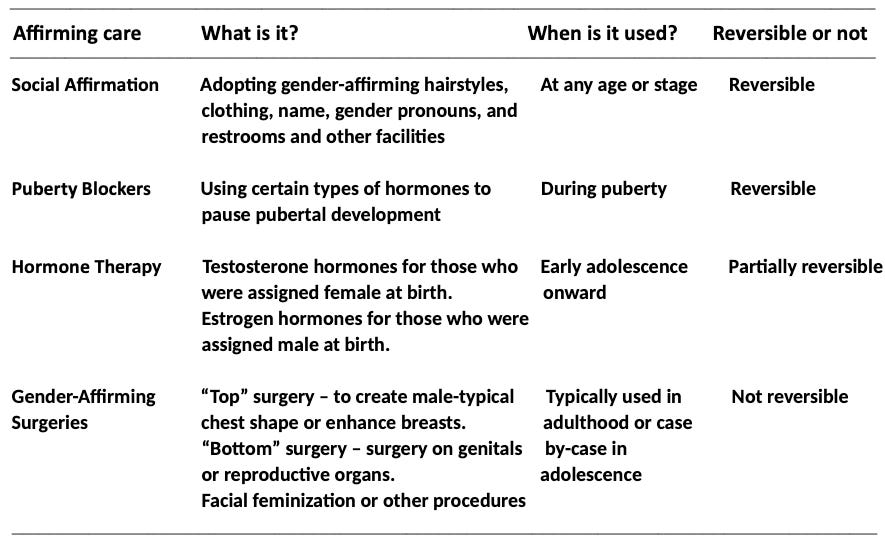
“Gender-affirming care is a supportive form of healthcare. It consists of an array of services that may include medical, surgical, mental health, and non-medical services for transgender and nonbinary people. For transgender and nonbinary children and adolescents, early gender-affirming care is crucial to overall health and well-being as it allows the child or adolescent to focus on social transitions and can increase their confidence while navigating the healthcare system.”
And the page then continues:
“Research demonstrates that gender-affirming care improves the mental health and overall well-being of gender diverse children and adolescents. Because gender-affirming care encompasses many facets of healthcare needs and support, it has been shown to increase positive outcomes for transgender and nonbinary children and adolescents. Gender-affirming care is patient-centered and treats individuals holistically, aligning their outward, physical traits with their gender identity. Gender diverse adolescents face significant health disparities compared to their cisgender peers. Transgender and gender nonbinary adolescents are at increased risk for mental health issues, substance use, and suicide. The Trevor Project’s 2021 National Survey on LGBTQ Youth Mental Health found that 52 percent of LGBTQ youth seriously considered attempting suicide in the past year. A safe and affirming healthcare environment is critical in fostering better outcomes for transgender, nonbinary, and other gender expansive children and adolescents. Medical and psychosocial gender affirming healthcare practices have been demonstrated to yield lower rates of adverse mental health outcomes, build self-esteem, and improve overall quality of life for transgender and gender diverse youth. Familial and peer support is also crucial in fostering similarly positive outcomes for these populations. The presence of affirming support networks is critical for facilitating and arranging gender affirming care for children and adolescents. Lack of such support can result in rejection, depression and suicide, homelessness, and other negative outcomes.”
Because of its many very obvious, outright false misrepresentations of important facts, this continuation of a formal government opinion (of the Biden administration) is, indeed, truly remarkable, though, to be fair, it also noted some correct observations. But that is not even the most offensive aspect of this document; the most remarkable aspect of this document published is the complete absence of any acknowledgment that some of the statements, even if one was willing to accept all of them as factually correct, by no means represent the scientific consensus and, at a minimum, therefore still must be considered to be controversial. The message the document conveys is, indeed, exactly the opposite.
This is confirmed by the Table below that completes the document and clearly supports all aspects of gender-affirming care—at least on a “case-by-case basis” in childhood and adolescence:
Who then can be surprised that the US medical establishment voiced no opposition to what was going on in so many hospitals and medical institutions, even though that stood—and to a degree still stands—in opposition to what happened in Europe. While especially in some Western European countries, similar practice trends started evolving as in the US, they reached an almost absolute halt after the so-called Cass Review was published in the UK in April of 2024, a three-year review conducted by a prominent British pediatrician, Dr. Hillary Cass, on behalf of the British National Health Service (NHS) in her role as Chair of the Independent Review of Gender Identity Services for Children and Young People.6
Key findings, and not only their content, but also their tone, reflective of obviously rather limited certainty, very clearly distinguished this report from the above-noted US DHHS document.
There is no simple explanation for the increase in the numbers of predominantly young people and young adults who have a trans or gender-diverse identity, but there is broad agreement that it is a result of a complex interplay between biological, psychological, and social factors. This balance of factors will be different in each individual.
There are conflicting views about the clinical approach, with expectations of care at times being far from usual clinical practice. This has made some clinicians fearful of working with gender-questioning young people, despite their presentation being similar to many children and young people presenting to other NHS services.
An appraisal of international guidelines for care and treatment of children and young people with gender incongruence found that that no single guideline could be applied in its entirety to the NHS in England.
While a considerable amount of research has been published in this field, systematic evidence reviews demonstrated the poor quality of the published studies, meaning there is not a reliable evidence base upon which to make clinical decisions, or for children and their families to make informed choices.
The strengths and weaknesses of the evidence base on the care of children and young people are often misrepresented and overstated, both in scientific publications and social debate.
The controversy surrounding the use of medical treatments has taken focus away from what the individualized care and treatment is intended to achieve for individuals seeking support from NHS gender services.
The rationale for early puberty suppression remains unclear, with weak evidence regarding the impact on gender dysphoria, mental or psychosocial health. The effect on cognitive and psychosexual development remains unknown.
The use of masculinizing/feminizing hormones in those under the age of 18 also presents many unknowns, despite their longstanding use in the adult transgender population. The lack of long-term follow-up data on those commencing treatment at an earlier age means we have inadequate information about the range of outcomes for this group.
Clinicians are unable to determine with any certainty which children and young people will go on to have an enduring trans identity.
For the majority of young people, a medical pathway may not be the best way to manage their gender-related distress. For those young people for whom a medical pathway is clinically indicated, it is not enough to provide this without also addressing wider mental health and/or psychosocially challenging problems.
Innovation is important if medicine is to move forward, but there must be a proportionate level of monitoring, oversight and regulation that does not stifle progress, while preventing creep of unproven approaches into clinical practice. Innovation must draw from and contribute to the evidence base.
CONSEQUENCES — that followed universally in almost all European countries following publication of the Kass Review were prohibitions of irreversible treatments—including puberty blockers—of children and young adults (age ranges differed between countries). But proponents of such treatments also in the UK were not willing to give up the fight and, as the BMJ recently reported, two studies—one at King’s College London and the other through the Maudsley NHS Foundation Trust in South London will now formally study the risks and benefits of giving puberty blockers to young people with gender incongruence. Despite opposition from some prominent scientists who, because of the young age of the study subjects, consider such studies “unethical” if there is “no likely clear benefit” for the children, both studies received ethical and regulatory approvals.7
THE MOST RECENT LITERATURE — Surprised by how little clinical experiences with transgender medicine had entered the literature in reproductive medicine, we recently were pleasantly surprised to find a narrative review in F&S Reviews, which appears to be evolving as the most interesting of the new F&S journals. The authors of this Review investigated the possibility of oocyte and sperm cryopreservation after medical transition. They concluded that there were differences in outcomes between transgender males and females: For transgender males, successful fertility preservation (of oocytes) turned out to be possible with relative ease even after transition, while for transgender females, the preservation of semen and estradiol supplementation reduced fertility potentials significantly.8
A RECENT BOMBSHELL ARTICLE — provided the incentive for this article, and where else is it from, but from a very recent posting of The Free Press.9 Under the heading, “We’re All Just Winging It”: What the Gender Doctors Say in Private.
The writer, Leor Sapir, in her article, fully reveals the ugly inhumanity behind gender medicine. In footage exclusively obtained by The Free Press, what the article calls “gender doctors” in the U.S. acknowledged that they perform life-altering procedures on vulnerable youth with no supportive evidence – and “are proud of it!”
All of those overheard conversations took place at a medical conference (closed to the press and “outsiders”) where “gender doctors”—as Sapir noted in her article—“allowed themselves to speak freely.” In a video from the 2021 conference of the US Professional Association for Transgender Health, a social worker from the Transgender Health Program at Oregon Health & Science University (OHSU) – of course a highly regarded academic institution especially in reproductive medicine—described an 18-year-old recent high school graduate who had expressed a desire to “look like Barbie down there,” as he was asexual and had no desire to ever have sex in the future.
Only relatively recently, as Sapir pointed out in her article, would such a young male patient have been given a psychological evaluation and mental health counseling. Now, “gender doctors” want to help young people (like this one) to achieve their gender goals.”
And the speaker, indeed, complained that—considering that the demand for such nonbinary gender modifications is rapidly growing—so-called surgical nullification procedures (individuals are left without any external genitalia) or penile preserving vaginoplasties (building a pseudo-vagina below the penis) “are not as accessible as they should be.” Another psychologist concurred and went even further by commenting that mental health professionals must “reframe” their role from being a gatekeeper to being a collaborator with the patient, meaning to “make sure that patients with serious mental health problems such as multiple personalities and psychosis are not excluded from gender surgery just because the team is uncomfortable operating on them.”
Much of what was revealed in Sapir’s article was based on court cases. Proponents of surgical transition procedures often relied on the “expertise” of the World Professional Association for Transgender Health (WPATH) and its U.S. chapter (USPATH), claiming through its “Standard of Care Guidelines “unassailable guidance for how to treat young people with gender dysphoria or any other form of “distress” over one’s biological sex.
But, as it turned out, WPATH was anything but unassailable: In court proceedings, it was, indeed, alleged that WPATH had suppressed reviews of published evidence which had concluded that available evidence in support of hormonal and surgical treatments for minors was not at all credible. The society was also accused of financial conflicts of interest and eliminated age restrictions for such treatments for minors for “explicitly political reasons.” The Free Press article noted that the WPATH’s misconduct was documented by The New York Times, The Economist, The Washington Post, City Journal, and—as the only medical journal—the BMJ.
Hundreds of videos from medical conferences organized by WPATH and USPATH, which The Free Press was able to review, stemmed mostly from litigation in the state of Alabama. In her article, Sapir noted that these videos offered a window into how “gender physicians” speak differently to each other when they think outsiders aren’t listening, from what they tell the wider medical community and the public at large.”
She was especially incensed by those recordings about how clinicians openly acknowledged performing unproven (and, therefore, experimental) surgical treatments, without a protocol to be followed and/or ethical Review by an ethics board, as every human research requires. Moreover, she claimed to have heard from practitioners in those videos acknowledgments that their goal was “to fulfill the ‘embodiment-desires’ of their patients, whatever they may be, even if by doing so, this may require deviating from guidelines.”
To define the term “embodiment goals,” the article describes a case presented at the 2022 WPATH conference involving a 13-year-old boy who identified as nonbinary (“she/they”) whose stated goals were: “I want tits, and I want my parts to still work” (on a side note, his accompanying parent also identified as non-binary). Another case presented (OHSU physicians presented both of these cases) was a teen who “had realized that Frank-N-Furter from The Rocky Horror Show was his gender identity.”
At the 2022 WPATH conference in Montreal, a British endocrinologist (a consultant under UK titles) acknowledged that interventions are based on little or no evidence of efficacy. The article quoted him as—remarkably—acknowledging a disturbing truth:
“We are doing procedures here where we don’t have outcome data. So unless you want to go to individual ethics boards in each hospital to get ethics permission to do those surgeries because they’re on the edge of the field of medicine, you need to have a mechanism around you to support you. Otherwise, you could be vulnerable. That’s our feeling.”
The ignorance and narcissism of this physician are simply mind-blowing!
A, for-a-change female physician “had no problems with the novelty of nonbinary procedures” and even liked to offer her patients a “kind of Pinterest board” of gender-changing procedures. She was then also quoted as saying on a video that, “she (and other WPATH clinicians) were making it up as they went along.” More specifically, the article quotes her as saying: “I feel like we’re all just winging it, you know? And which is ok, you’re winging it too. But maybe we can just, like, wing together!”
The article then also addresses the resurgence of Eunuchism, which WPATH has reframed as the desire for castration as a gender identity issue. They may be aware of their identity already in childhood or adolescence and, of course, also represent a marginalized group, deserving of attention and understanding.
But the field is not standing still: A prominent Dutch practitioner in 2024 argued that the field of gender medicine was now ready to move beyond just a “logic of improvement” (i.e., achieving credible mental health benefits). It instead should be striving to achieve “gender euphoria” and “creative transfiguration,” with the latter meaning to view the body as a “gendered art piece” that can be made ours through transition-related interventions. Sapir appropriately pointed out the absurdity of these conclusions because what they would mean is that clinicians treating transgender patients no longer see themselves as treating a mental disorder but, for all practical purposes, as only plastic surgeons.
One, moreover, could also argue that they are pursuing insurance fraud by claiming mental health benefits on their insurance claims and are simply outright lying to patients and the public when claiming to be performing” lifesaving procedures.” How bizarre!
But the outrage goes even further: In internal discussions, many conference participants openly—and it appears even proudly—proclaimed that they routinely do not conduct mental health assessments of their patients or even assess their gender identity but, simply, execute the patients’ cosmetic “goals.” If this is a juvenile, such treatments may have irreversible consequences for that youth’s subsequent life. How shameful!
CONCLUDING — I am purposely leaving out politics from here discussion presented. This, of course, does not mean that I’m not worried about the potential circular impact political change can have on transgender medical care. President Biden considered the transgender movement “the civil rights issue of our times.” Suffice it to say, President Trump not only disagreed but issued an executive order that mandated federal agencies to end all medicalized transitions of minors. Who knows what New York’s mayor-elect Zohran Mamdani—a sworn advocate of youth transition—has in mind; he, during the election campaign, promised to spend $65 million for expanding and protecting gender-affirming care citywide for transgender youth as well as adults.
But within such a context, I am also pleased to quote Sapir’s article in regard to public opinion:
“More than seven in 10 Americans, including more than half of Democratic and Democratic-leaning voters, believe minors should not be offered puberty blockers or cross-sex hormones.”
Once more, the public appears to have more common sense than the so-called experts and, of course, politicians. If 70% of Democratic voters oppose puberty-suppressing and other hormonal treatments, even more Republican-leaning voters will have the same opinion. And if such large majorities even opposed gender-bending medical treatments, the opposition to irreversible surgical interventions must be even higher. A “hurrah” for common sense!
References
Reed J. The Free Press. February 9, 2025. https://www.thefp.com/p/i-thought-i-was-saving-trans-kids
Reed R. The Free Press. September 29, 2024. https://www.thefp.com/p/tiger-jamie-reed-detransition-wash-u-
transgender-affirming-care
Narayan et al., Ann Transl Med 2021;9(7):605
MacKinnon et al., JAMA Network Open 2022; 5(7):e2224717
Office of Population Affairs, DHHS, https://opa.hhs.gov/sites/default/files/2023-08/gender-affirming-care-young-
people.pdf. Accessed 12/9/2025.
Cass H. The Cass Review.
https://webarchive.nationalarchives.gov.uk/ukgwa/20250310143933/https://cass.independent-review.uk/home/publications/final-report/
Waters A. BMJ 2025;391:r2478
Le et al., F&S Rev 2025;6(2):100093
Sapir L. The Free Press. December 3, 2025. https://www.thefp.com/p/were-all-just-winging-it-what- the utm_source=substack&publication_id=260347&post_id=180648411&utm_medium=email&utm_ content=share&utm_campaign=email-share&triggerShare=true&isFreemail=false&r=5dj1m5&triedRedirect=true