

A PIECE OF MY MIND - The Upcoming 25th Anniversary of CHR-NY

Today’s posting is quite different from our usual material because 2026 is not only the Semiquincentennial, i.e., the 250th anniversary of the United States Declaration of Independence - but also the 25th anniversary of the CHR’s formal move from Chicago to New York City into its current location. To celebrate this event, the CHR is planning an Anniversary Gala on September 9, with all the proceeds benefitting the not-for-profit Foundation for Reproductive Medicine (FRM), which supports postgraduate medical education and research at the CHR and elsewhere and has done so for decades.
The FRM, therefore, is in 2026 co-sponsoring with the CHR two major events in NYC, - the above-noted Gala at one of the city’s premier event spaces, Guastavino’s, on September 9 and - as usual - the annual international Foundation for Reproductive Medicine Conference (FRMC) between December 4 and 6 at the Metropolitan Club.
This, of course, means a lot of extra work for the CHR, as well as the FRM, which we very much want to support. Consequently, we felt a brief rehash of the CHR’s history was timely and asked the CHR’s Medical Director and Chief Scientist, Norbert Gleicher, MD, to use his periodic “A Piece of My Mind” article to tell in brief the stories of the CHR and the FRM. He, after all, several decades ago, founded both organizations.
And the purpose is, of course, to invite our readers to both of these events, with the appendix after the article offering the links to make reservations and/or request further information.
The CHR’s Editorial Staff
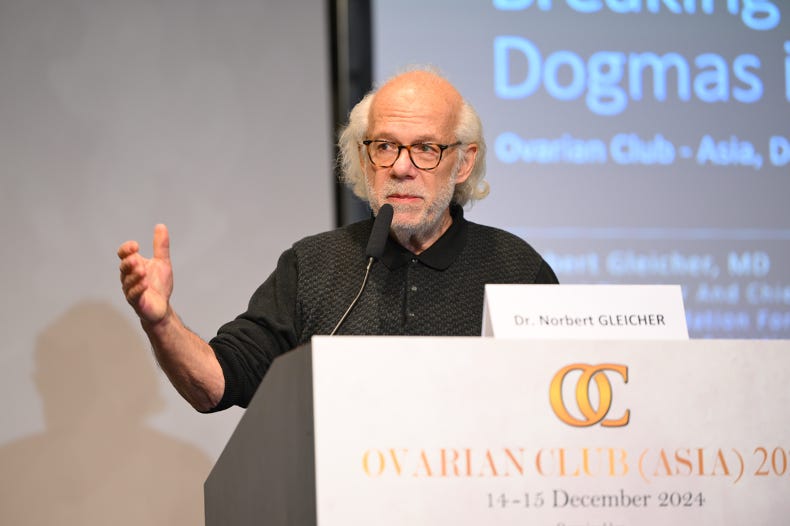
A PIECE OF MY MIND - The Upcoming 25th Anniversary of CHR-NY
By Norbert Gleicher, MD, Medical Director and Chief Scientist, at The Center for Human Reproduction in New York City. He can be contacted though the CHRVOICE or directly at either ngleicher@thechr.com or ngleicher@rockefeller.edu.
In September, the CHR will celebrate a quarter of a century in its current location in NYC with a very special Gala - obviously a very special occasion with very significant meaning for the CHR’s future. Having had the honor of establishing the CHR as an academic faculty practice at Mount Sinai Hospital in Chicago in 1981 as Chairman of the OB/GYN department, I have led the CHR organization ever since, - initially moving it out of its academic model into a private economic model in Chicago and later moving - for reasons explained below - the main practice from Chicago to NYC. This “A Piece of My Mind” article is meant to inform our readers about the CHR’s plans for the future.
Background
Though private since approximately 1990, the CHR remained “academic” in its goals as well as structure, - likely, indeed, more so than many - if not most - academic institutions. This is well documented by hundreds of peer-reviewed publications, and many discoveries that have changed clinical infertility practice and led to the CHR’s worldwide recognition as a leading last-resort fertility center for patients with repeated IVF failures. In parallel, the CHR (through its investigators) has also become one of the most cited fertility provider organizations in the medical literature in the world.
The CHR’s research program would not have been possible without financial help from the not-for-profit Foundation for Reproductive Medicine (FRM), which has steadily supported the CHR’s educational and research activities. Though the foundation has over the years been mostly funded by the CHR, tax-deductible donations mostly from the CHR’s patients and outside grants have also greatly contributed to the CHR’s educational and research efforts.
In planning the CHR’s 25th Anniversary in NYC, all financial net-proceeds from the Anniversary Gala on September 9 will, therefore, go to the FRM (tickets and donations are tax-deductible according to the law) to continue support of educational events like the annual Foundation for Reproductive Medicine Conference (FRMC), - this year on December 4-6 again at the Metropolitan Club. The proceeds will also continue to support basic science as well as clinical research mostly at the CHR, though at times also at other fertility service providers.
After many years at the helm of this wonderful organization, the time has now, however, come to think about transitioning the CHR into its future under the next generation of leadership. This year, the CHR, therefore, initiated a carefully thought-out 5-year transition period toward new leadership and a principal purpose of this article is, therefore, to be transparent in all aspects of this process.
An important aspect in this transition is to secure the future of the CHR as a leading research center in the fertility field. Considering, however, the fact that - though working closely with several academic institutions in the world, - in NYC, for example, with Rockefeller University, in Europe, with the city of Vienna’s Medical University, and in Israel, with several of the country’s universities, - the CHR is not part of a university or a major hospital organization per-se.
Maintaining the CHR’s ability to conduct important research into the future as a free-standing fertility center is, therefore, a crucially important goal of this transition process. And the responsibility for financially supporting this ability – as in the past – will continue to rest with the FRM, a not-for-profit foundation, which over the years, has been providing the financial support for most of the CHR’s postgraduate education efforts as well as its research program.
To establish the beginning of an endowment for the FRM in supporting education and research at the CHR into the future, we, therefore, committed all net income for the upcoming 25th Anniversary Gala of the CHR in NYC to the FRM and we hope that you – our readers – will help us in doing so by joining us in those festivities on September 9 at one of NYC’s most amazing event spaces, - Guastavino’s at 409 East 59th Street (see below) for a night of good food, music, and entertainment, as well as purpose. With the event organized by the FRM in collaboration with the CHR, tickets and donations are tax-deductible according to the law. CHR babies above age 14 are welcome for free.
The gala will honor a leading pioneer in reproductive biology research in the country, Prof. David F. Albertini, PhD, upon his upcoming retirement after more than 15 years as editor-in-chief of the Journal of Assisted Reproduction and Genetics (JARG), the first journal in the world dedicated to in vitro fertilization (IVF). He for several years also served as Director of the CHR’s Division of Laboratories and is still a Visiting Senior Scientist at the CHR. And at the same time, the Gala will also announce and honor the CHR’s “Patient of the Year.”

A Little Bit of History
With the formal opening of our new infertility center in its current brownstone location at 21 East 69th Street in Manhattan on September 10, 2001, the CENTER FOR HUMAN REPRODUCTION (CHR) celebrated its formal move from Chicago to NYC. Before that, in an agreement with Columbia University, CHR had farmed out the running of its new NYC program to the Columbia University’s IVF faculty, - a business relationship that from the beginning did not work out well and therefore after only one year was terminated.

It was this decision that, indeed, ultimately led to the CHR’s move to NYC after its founding roughly 20 years earlier in Chicago as the OB/GYN faculty practice at Mount Sinai Hospital, where I was the department’s Chairman. The CHR’s IVF program became one of the earliest in the nation and was the first in all of the Midwest. IVF clinics in 1981 were still such a rarity that the Chicago Tribune, the city’s leading newspaper, over two consecutive days published two full pages about the opening of the CHR’s IVF clinic.
In collaboration with Columbia University, the original NYC location of the CHR was in a rented space on Madison Avenue, just a few blocks below our current location on 69th Street. That space, since then, has been occupied by another prominent IVF clinic.
The Opening Party
Though the move into the CHR’s current location took place in late July of 2001, things were not settled enough for a formal opening party until September 10. On that day then, however, over twice as many guests as expected showed up because an international embryology conference had brought many colleagues from all over the world to NYC. Once they found out about our party, many came to celebrate with us and we, of course, welcomed them with open arms. We, indeed, considered this coincidence a wonderful omen for what was to come for the CHR, - and we were not incorrect!
For the next day - the infamous September 11, 2001, - we had scheduled a GrandRounds event at The Russian Tea Room, for which over 200 local gynecology colleagues had registered. Unsurprisingly, of course, this event never took place!
Now, almost 25 years after these two forever unforgettably linked days, the CHR will, on September 9, 2026, be celebrating its 25th Anniversary in NYC with yet another, - even bigger party, - this time a Gala with good food, dancing, and other entertainment at Guastavino’s. And this time, we are hoping for even more guests, - a good number again from overseas - even without a medical conference in town.
After 25 years at the current location, the CHR is today a very different organization from what it was then. In this quarter of a century, the CHR, because of its research and clinical accomplishments, has evolved from a well-known U.S. fertility center to a worldwide recognized fertility center of last resort, - recognized as such not only by patients and colleagues, but also by practically all current AI platforms.
Some of the Most Special Research Accomplishments of the CHR Over the Years
• The first IVF center in the Midwest (in Chicago) and one of a small number of first-generation IVF clinics in the U.S.
• I was given the honor of being appointed as the founding Editor-in-Chief of the world’s first IVF journal, The Journal of In Vitro Fertilization and Embryo Transfer (J IVF-ET), later renamed to its current name Journal of Assisted Reproduction and Genetics (JARG), a position I held for almost 20 years. I was followed in this appointment by David F. Albertini, PhD, a past Laboratory Section Head at the CHR and now for many years a Visiting Senior Scientist. And he, of course, will also be the principal science honoree of this year’s 25th Anniversary Gala in September.
• Concomitantly, I was also appointed as the Founding Editor-in-Chief of the American Journal of Reproductive Immunology (AJRI), which I also led for almost 20 years.
• The CHR became one of the leading clinical and research centers in Reproductive Immunology in the world, with such giants of the field as Alan Beer, MD, and Carolyn Coulam, MD, joining the CHR in Chicago.
• The CHR performed the first vaginal egg retrieval in the world, - reported in The Lancet, which radically changed IVF practice by taking IVF out of the operating room (egg retrievals until then were performed by laparoscopy only).
• The CHR performed the first transvaginal tubal catheterization procedure to unclog obstructed fallopian tubes and, shortly thereafter, reported a multicenter study of this new procedure in the Journal of the American Medical Association (JAMA), which established beyond reasonable doubt that an ambulatory procedure without anesthesia could in many cases replace major tubal surgery.
• After moving to New York City, the CHR was the first to report the benefits of androgen supplementation in hypo-androgenic infertile women, - a subject addressed since then in over 40 peer-reviewed publications and awarded several U.S. patents.
• In 2006 – after recalculating published studies by Belgian investigators – the CHR’s investigators were the first to argue that the chromosomal testing of embryos (then called preimplantation genetic screening, PGS, and now called preimplantation genetic testing for aneuploidy, PGT-A) did not - as claimed - improve IVF cycle outcomes and in older women, indeed, could reduce pregnancy chances. Their paper was, however, uniformly rejected by medical journals until Dutch colleagues reported a prospectively randomized study making exactly this point in The New England Journal of Medicine, at which time the Editor-in-Chief of Fertility and Sterility, who previously rejected the paper, recalled and published it in 2008. The American Society for Reproductive Medicine (ASRM) only in September of 2024 in a formal policy statement for the first time recognized that PGT-A did not improve any IVF cycle outcomes in unselected patients.
• In 2009, I was honored by the British Fertility Society as an IVF pioneer by being invited to deliver the Patrick Steptoe Memorial Lecture, one of the Society’s most prestigious distinctions, “Recognizing major contributions to reproductive medicine.” This lectureship is awarded only to internationally recognized leaders in the field, and pioneers in IVF and reproductive endocrinology.
• In 2015, the CHR’s investigators were the first to report that the intrafollicular metabolism of ovarian follicles was speeding up with advancing female age, resulting in progressively earlier luteinization of follicles, - only preventable by progressively earlier retrievals. In doing so, the CHR broke a dogma in IVF that existed since the earliest days of the procedure, - that IVF cycles should be triggered only once the lead follicle reaches a size of 18-23 mm.
• In 2023, CHR investigators, moreover, were the first to report that nature also appears to support earlier egg retrievals as women age by breaking another IVF dogma that existed since the earliest days of the procedure, - namely that the different maturity grades of oocytes, - MII (mature), MI (mildly immature), and GV (very immature) - maintained their levels of functionality with advancing age in producing good-quality embryos by demonstrating that mature MII oocytes (in IVF routinely the desired maturity grade to this day) progressively lost this ability while severely immature GV oocytes progressively improved their ability to produce good-quality embryos (mildly immature MI oocytes maintain their ability, though demonstrate a mild trend toward improvement).
• In 2025, the CHR’s investigators filed a patent that describes a sonographic phenotype of follicles that allows judgment about a follicle’s (and its oocyte’s) maturity and thereby further improves the timing of ovulation trigger and egg retrieval. In conducting this research, the investigators discovered that a third longstanding IVF dogma had been broken, which assumed that the largest follicle always contained the most mature oocyte.
Many more “firsts” have been reported in all those years in over 500 peer-reviewed CHR publications in reproductive immunology and on genetic subjects (the CHR, for example, has reported important findings regarding the FMR1 gene, - also called the fragile X gene) and regarding a variety of widely used IVF practices often called “add-ons” to IVF.
The Single Most Important CHR Accomplishment
Likely the most important contribution of the CHR to infertility practice – and still not recognized by far too many colleagues - has been the fact that the CHR never accepted the widely-held notion in the IVF field in the U.S - and really worldwide - that women after ages 42 to 43 practically no longer have reasonable pregnancy chances with their own (autologous) eggs and, therefore, at those ages, should be automatically advanced into third-party egg donation.
By not accepting this notion, the CHR was forced to improve IVF outcomes in older women and/or in younger women with premature ovarian aging (POA). As a consequence, the CHR – in contrast to most other IVF clinics – slowly “learned” through in-house research (all published) how - egg by egg and embryo by embryo - IVF cycle outcomes could even be improved in old women. The CHR’s so-far oldest patient who delivered an autologous child after IVF (of course, also reported in the literature) was two weeks short of her 48th birthday when transferred. She, to this day, has remained the oldest patient having had a healthy delivery following this type of IVF in the medical literature, even though a slightly older CHR patient conceived but – unfortunately – miscarried.
Now serving the by-far oldest infertile patient population in the U.S. (our median patient age in the last 3 years was between 44 and 45 years vs. 36 years for all U.S. IVF clinics) – and likely in the world – the CHR has been successful in improving pregnancy rates in women who have at least one cleavage-stage (day-3) embryo for transfer from 8% in 2022 to 10% in 2023, and to 12% in 2024 and 2025 (the manuscript reporting these improvements is in Reprod Biomed Online).
While these are, of course, much lower numbers than achieved in younger infertile women, they significantly exceed widely quoted rates that many colleagues use in their discussions with women above age 42-43 (the pregnancy chance often quoted is only 1% to 2%). These numbers, of course, establish a radically wrong paradigm for patients, which can be difficult to overcome when it is presented as fact by their treating physicians since it, of course, then fully supports the argument new presenting patients at the CHR almost always quote to have been exposed to, - that “third-party egg donation represented their only reasonable remaining pregnancy chance.”
We are “fighting for every egg and embryo,” which has been a principal motto at the CHR over many years. While following this motto has been a slow and rather arduous fight within the community of providers of fertility services, it - nevertheless - has been highly rewarding, and not only for the worldwide patient clientele the CHR has come to serve over the years, - but for us - the CHR staff - who feel especially rewarded for having had the privilege of learning and applying new treatments that between 2022 and 2025 allowed the CHR to increase patients’ chances to conceive with their own eggs by one third!
And the Circle Closes – Transitioning the CHR to a New Generation, while Expanding Educational and Research Support Through the Not-for-Profit FRM
We very much hope to see many of our past and current patients, colleagues, whether in labs or on the clinical side, whether collaborators or friendly competitors and, of course, as many friends and purveyors as possible at our 25th Anniversary Gala on September 9 at Guastavino’s. And, as already noted, if your CHR babies are over 14 years old or if you yourself reading this are a CHR baby, you are invited for free and we will have special tabs for CHR babies (even if still in the uterus).
Not only is the Gala going to be a fun event with great music in a spectacular space and with very good food, but – hopefully, like the FRMC, it will become an annual event. Now in its 8th year, the FRMC for several reasons greatly impacted the fertility field internationally from the very beginning. There were the mottos, “Think differently” and “Hear it for the first time,” clearly distinguishing the conference from everything else offered anywhere in the world.
And then there was the principal idea behind the conference, - over two-and-a-half days bringing together leading basic scientists and clinicians in one (fancy) room of the Metropolitan Club with clinicians learning what was new in research laboratories and basic scientists from those laboratories learning what knowledge clinicians needed developed in their labs.
Such a conference did not exist anywhere else in the world before the FRMC came about, though some have - with limited success - started to try to copy some of its features since then. But certain ideas are hard to duplicate, such as choosing the right topics and faculty of speakers. And apropos speakers, getting invited as a speaker has achieved a certain cachet, reflecting recognition of the impressive nature of a speaker’s work. To be invited as a member of the faculty club has, therefore, become quite popular.
That the conference always takes place on the weekend following Thanksgiving, smack in the middle of the pre-Christmas/Chanukah shopping season, also does not hurt (who does not want to shop in NYC at that time?). Of course, it’s also an expensive time to organize a conference in NYC because of high venue costs.
The annual FRMC and the hopefully soon-to-be annual FRM Gala, this year celebrating the CHR’s 25th Anniversary in NYC, are the two big FRM events of 2026; but they are not all the foundation is doing. There are the almost monthly GrandRounds that bring prominent speakers to the CHR, - often later also participating in the FRMC. And then there are the fellowships the FRM sponsors intermittently at the CHR. The CHR, for example, would not have had the opportunity to discover what a star Sonia Gayete-Lafuente, MD, PhD, really was in the field of infertility – and, therefore, hire her into a senior attending physician position at CHR – were it not for the FRM fellowship she held for two years before that.
The CHR, therefore, over the years has become increasingly dependent on the FRM. Considering the notably increasing growth of the CHR over the last year, the CHR had to be hyperactive to meet its educational and research needs. In the appendix to this article, readers, therefore, will find the links for attending this year’s 25th Anniversary Gala on September 9, 2026, and/or registering for the 2026 FRMC between December 4 and 6, 2026. The Gala offers individual seating (if you have preferences with whom you would like to sit, - please let us know; we will do our best to accommodate you) or, if you want to invite your whole family, your office, or just a bunch of friends, tables that seat either 8 or 10 people.
The more we see of you, the happier you make us!
The appendix also offers information about other FRMC-related topics, like the abstract submission deadline and link, and the greatly reduced early bird registration fees for the FRMC (along with various other discounts).
Finally, the FRM very much welcomes donations to the foundation’s general endowment fund, which, of course, are deductible according to the law. If you have questions regarding reservations for the Gala, registrations for the FRMC, or potential donations to the FRM, please contact Lyka Mochizuki, MS, who is our case manager for both events. She can be reached by email at lyka@thechr.com or by telephone through the CHR operator at (212) 994 4400.
As we already noted in an earlier section of this article, the CHR and, therefore, with it the FRM, have in 2026 started a 5-year transition period toward a next generation of leadership and we are hoping in the process to expand the current footprints of postgraduate educational activities and research support in an attempt to take advantage of the truly unique patient population the CHR has come to serve.
We are certain that no other IVF clinic in the U.S. or anywhere else in the world serves a similarly selected patient population, especially because the CHR’s patients are on average almost 10 years older than patients in all other U.S. IVF clinics (and probably also in clinics elsewhere in the world). The CHR, therefore, has many unique opportunities for research, and so do pharma and other industrial companies with a commercial interest in the infertility field.
We are looking forward to seeing you at both events. The gala will offer good food, fun, and dancing; the FRMC will be hard work but also plenty of fun at our social events.
APPENDIX
25TH ANNIVERSARY GALA
Date: Wednesday, September 9, 2026 • 7pm
Venue: Guastavino’s, 409 East 59th Street, New York, NY
Table Reservations (seats of 8 or 10): 8 -- $6,500) 10 -- $8,000) for family members, colleagues, and/or friends here: https://givebutter.com/chr-25th-anniversary-gala-5eogtt
Individual Seating ($750 per person):
Please indicate any seating preferences with others when you register and reserve here: https://givebutter.com/chr-25th-anniversary-gala-general-admission-4icmdx
“CHR babies” above age 14 are welcome to attend free of charge — please email gala@thechr.com or call (212) 994-4400 to arrange your tickets. Tickets and donations are tax-deductible as determined by law. The Foundation for Reproductive Medicine is a 501(c)(3) organization, EIN 81-4615550.
General donations to the Foundation are also welcome at: https://www.zeffy.com/en-US/donation-form/because-every-family-deserves-more-time-help-us-fund-the-research-that-gives-it-to-them
2026 FOUNDATION FOR REPRODUCTIVE MEDICINE CONFERENCE (FRMC)
Dates: December 4–6, 2026
Venue: Metropolitan Club, 1 East 60th Street, New York, NY
CME-accredited for up to 20 AMA PRA Category 1 Credits™. RNs and NPs can earn 20 CBRN-approved CE credits.
Registration: Early-bird and several other discounts are available here: https://whova.com/portal/registration/GM2LL8NP2n7gCLCnO9y-/
Interns, residents, and postdocs – with a certification letter from their department or laboratory – are offered free registration.
Abstract Submissions:
Deadline: September 18, 2026. Previously unpublished submissions are accepted in basic reproductive biology and clinical reproductive endocrinology and infertility, following standard ASRM abstract format. Submit via email to jtapper@thechr.com. Accepted abstracts will be given a 15-minute time slot for an oral presentation (10 minutes presentation, 5 minutes discussion) on Saturday, December 5.
A BEST POSTER AWARD OF $1,000 will go to one or up to 3 submitted posters.
For more information, visit https://www.foundationforreprodmed.com/ or contact Lyka Mochizuki, MS, Project Manager of CHR and FRMC, at gala@thechr.com or (212) 994-4400 ext 4435.