


Today’s two postings are not about clinical issues but addressing aspects of the “business of medicine” in some generality (and, yes, medicine is, of course, business, - whether we like it or not) but, of course, with special relevance to the infertility field.
And – to be honest – especially the second posting also offers a little bit gossip, - yet involving an in the CHR’s opinion very important issue, - the correct diagnosis of singe gene diseases in embryos and their potential “cure” through genomic editing of the embryo’s germline.
A few interesting things have been happening recently in NC scientific society which we feel should be of interest to our readers because they in many ways represent follow-ups to prior articles in The Reproductive Times.
As always we are interested in your responses; so, don’t hold back!
The CHR’s Editorial Staff
About Venture Capital and Medical Start-ups
The Editorial Staff of the CHR
Venture capital (VC) has been less involved in the purchase of IVF clinics than Private Equity, - but, of course, is heavily involved in the start-up boom that also involves reproductive medicine. A recent article in The Wall Street Journal noted that health VCs in general are facing a tough market these days.1 The principal reason appears to be that VCs have recently “struggled to deliver returns to their limited partners.”
Several start-ups in the IVF field have, indeed, for some time been struggling. We recently had the opportunity to speak to the founder of one of these start-ups. It offered an A.I. program for embryo selection. It – at least initially – appeared to have received a warm welcome from the IVF community. But, somewhat disappointingly, we in this conversation learned that the company had indeed shut down recently.
The founder’s explanation was that potential clients (i.e., IVF clinics) just didn’t see a financial benefits from the program. CHR – in principle having for a good number of years been rather skeptical of the concept of embryo selection as a clinical concept in general2 – was, indeed, several years ago one of the first IVF clinics a co-founder of the company had approached for an opinion about their product. In retrospect, we apparently were correct in the skeptical assessment we had offered at that time.
But, as strange as that may sound, start-ups sometimes can also fail for non-economic and non-clinical reasons, - simply because important people in an organization can’t get along. A very recent start-up in NYC called Manhattan Genomics3 – again well known to the CHR since its founders contacted the CHR for advice very early after incorporation - serves here as a good example:.
Immediately following the public announcement of its founding, the company received substantial visibility in the media because its principal business plan involved genomic germline editing of embryos with single gene diseases in attempts to rescue these embryos and make them available for transfer in an IVF cycle. Considering the CHR’s highly adversely selected and older patient population, in which every transferrable embryo is considered its weight in gold, the business plan of this start-up company was of great interest for the CHR.
The company at that point had already raised US$ 1.5 million from an investor and was on the verge of opening a research laboratory in NYC when the two co-founders, Cathy Tie (CEO, and more on her in the next posting below) and Eriona Hysolli, PhD (CSO), contacted the CHR and the CHR’s Medical Director and Chief Scientist, Norbert Gleicher, MD, agreed to join the company’s Scientific Advisory Board. But his advice wasn’t needed for very long: on February 12, 2026, Tie, in an e- mail announced the return of the investment and dissolution of the company because the two founders could not agree on governance and corporate structure.
Too bad, - the company’s business plan not only appeared to be economically solid but, especially poor prognosis patients in autologous IVF cycles, also appeared to have a very promising purpose. The CHR, therefore, very much hopes that somebody will be ready to pick up the pieces and will be ready to collaborate because at the CHR every embryo is literally “worth gold.”
And, as already noted above, if you found this story of interest, you may also enjoy the relate next posting.
REFERENCES
1. Gormley B. The Wall Street Journal . February 14-15, 2026; pB10
2. Gleicher eta l., Hum Reprod Open 2025;2:hoaf011
3. Manhattan Genomics. https://manhattangenomics.com/
The “Chinese Dr. Frankenstein” is Back in the News and So Is “Biotech Barbie,”- his (ex)Bride
The Editorial Staff of the CHR
And – probably coincidentally – only a month before Cathie Tie’s above noted announcement about the shutting down of her new start-up, her first and former short-term partner in forming a genome company for the purpose of editing embryos with single gene diseases surfaced again – after considerable absence - in the news through an article in The New York Times.1
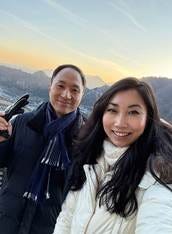
But before we get there, a few more words about Cathie Tie (see photos below), who already at age 15 worked as a student researcher in an immunology lab at the University of Toronto, dropped out of college in the first semester to become one of the earlier Thiel fellows, then started two companies in Silicon Valley, Ranomics a genetic screening company (at age 18), and Locke Bio, a telemedicine company, and recently was inducted into the Borad of Directors of Cold Spring Harbor Labs Association (a quite prestigious board, of course).
And like He, the media gave her nicknames: The FREE PRESS called her the Chinese “Frankenstein’s Bride” (see below the picture)2 and Nature magazine called her in view of her Silicone Valey history, - “Biotech Barbie.”3 And, so, we have here the story of the “Chinese Frankenstein” and his Bride, - ala, “Biotech Barbie.”
Over the years on several occasions in detail covered in the media and, of course, in the CHR VOICE, Jiankui He, PhD, was awarded the nickname China’s “Frankenstein” because he was allegedly sent to prison for 3 years by Chinese authorities after in 2018 editing – without prior permission - the germline of at least two embryos of one woman who gave birth to twins to induce in them HIV resistance and in one embryo of a second woman who also gave birth, - though less is known about her.

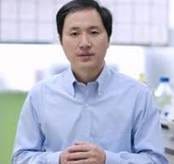
Though he did this in a major university with obvious local knowledge and support, Chinese government (local as well as federal) later denied any prior knowledge of his activities, even though they – initially – had publicly lauded them as breakthrough achievements.
In the West He, however, instantly became a scientific outcast because nobody saw a clinical reason for these genomic interventions (the father of the twins born from the 2 first embryos was HIV-positive) and, therefore, considered the two interventions to be highly unethical. Probably prohibited by the government – He, moreover, never supported his claims through a formal scientific publication. Western media, therefore, started giving him the nickname, the “Chinese Dr. Frankenstein,” and this name apparently has stuck as the recent New York Times article suggests!
Once released from the alleged jail sentence (there were rumors that he was only under house arrest), Jiankui He formed a business partnership with the in the preceding posting noted Cathie Tie - a serial Canadian entrepreneur – and a U.S. - based genomic company in Austin, TX. This partnership, however, for varying reasons (depending on whom you ask) never got off the ground. One alleged reason was that the Chinese government prohibited He from leaving China and allegedly denied Tie entry into China. And as The Times now reported, He’s prohibition to travel outside of China is apparently still maintained.
Yet He quite obviously refuses to remain quiet and gave Andrew Higgins from The New York Times the opportunity of an interview. Having always suspected the Chinese government of originally having supported He’s research, it, therefore, did not surprise the CHR to learn that He lives and speaks openly in a government-backed research hub north of Beijing. And, yes, - he is apparently boasting about his work,-claiming that China is ready to publicly and fully embrace him after all.
He also claimed in the interview to recently have been offered a position from a government-funded medical academy in Shenzhen (next to Hong Kong) and has restarted at his government funded laboratory in Beijing his research into germline editing of embryos (though only I a mouse model) to eliminate diseases like Alzheimer’s (which affected his mother) and Duchenne muscular dystrophy. China has since passed a law that prohibits human embryo editing, - but so what? China also agreed to no more nuclear testing, and was, of course, just recently caught doing it (see photo below)!4

And here is where the CHRVOICE offers breaking news, - not even The Times was able to discover: While Higgins in his article was able to clarify the so-far controversial question whether He and Tie were ever really married, - as several media reports suggested and Tie on and off herself confirmed and denied. The answer is apparently , - yes in 2024; but the marriage lasted apparently only less time than their above-noted jointly owned U.S. company and the more recently founded second company in NYC which Tie just shut down, - as reported above.
And the scoop?
One of several photos accompanying the New York Times article shows He in what the article describes as his palatial home in Beijing. And in the middle of an, indeed, palatial rotunda stands majestically a piano with open sheet music, - suggesting its recent use. He apparently plays the piano, - and so does Tie, who in April has allegedly rented out Carnegie Hall in NYC to give a piano concert for family, friends, and likely investors.
For all of those who wondered how come Tie married He in the first place, the answer is now a little more obvious: Not only because of their common obsession about genomic editing of embryos, not only because their names are riming so perfectly, - but – as the CHRVOICE here for the first time reports – very likely also because a piano centers their respective homes, with both, likely sharing in the love for playing the piano! What an interesting couple!
REFERENCES
1. Higgins A. The New York Times. January 15, 2025
2. Berkman J. The Free Press. August 10, 2025. https://www.thefp.com/p/the-bride-of-chinese-frankenstein-and
3. Ledford H. Nature 2025;647(8089):295-297
4. Rodgers J, Bermudez Jr. JS. Center for Strategic & International Studies . February 13, 2026. https://www.csis.org/analysis/satellite-imagery-analysis-chinas-alleged-2020-nuclear-test-lop-nur