

Do Embryologists Really Miss Substantial Numbers of Oocytes in Follicle Aspirates? We don’t think so!
The Editorial Team of the CHR
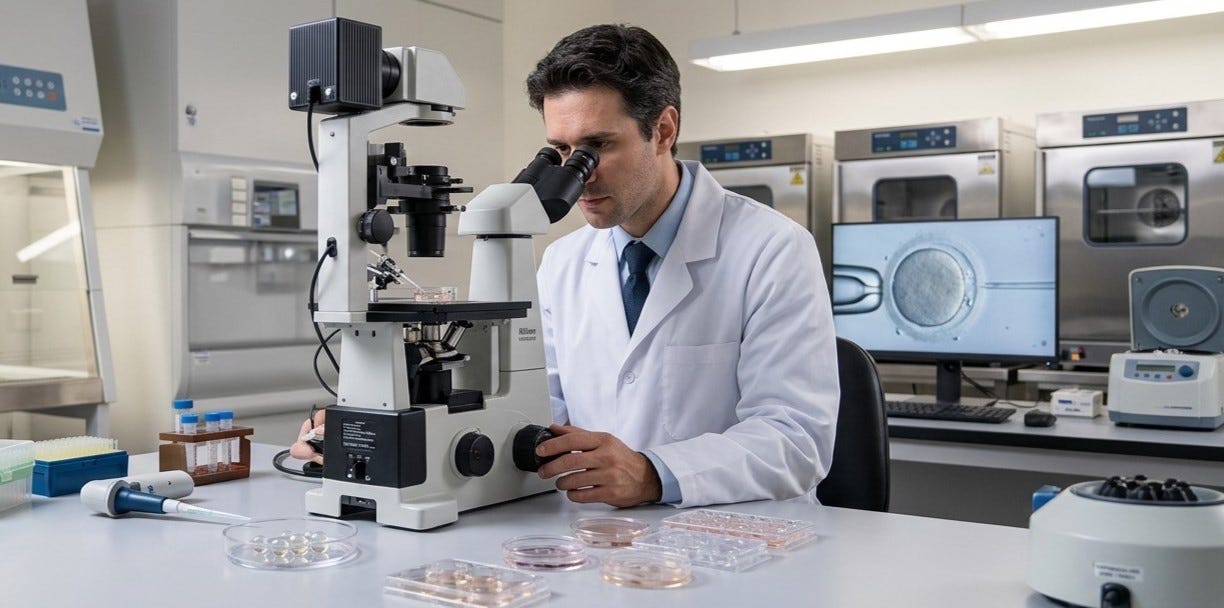
One of the never disappointing subjects we have been covering over and over here in the Reproductive Times as well as in the THEVOICE is the introduction of new treatments and diagnostics into IVF practice based on scant or often even completely absent validations. That, of course, does not mean that this always happens on purpose or even consciously by proponents of these new remedies, - but it is also undeniable that financial incentives and profit motives of companies very often lead to exaggerated claims.
We today address a very recent claim made in a paper published in one of the highest ranked medical journals in the world and – because of hos sensational it was – of course making headlines in many newspapers and other media outlets. The claim made was that embryologists in IVF clinics in over half of all cases fail to identify oocytes in follicular fluids obtained in IVF cycles at time of egg retrievals when following the over 40 years-old routine of manually searching under a microscope for oocytes. Utilizing instead a microfluid chip developed by the company that financed the study, the publication claimed significant added recovery of otherwise overlooked oocytes.
If true, this, of course, would be a highly significant finding because it would suggest that inadequate embryology “loses” eggs and, therefore, reduces the cumulative pregnancy chances of patients in IVF cycles. This claim was moreover further enhanced in its credibility by publication in a very prestigious medical journal.
But, as our today’s posting will make clear, - we are very skeptical about the claims made in this publication. Let us know what you think!
The CHR’s Editorial Staff
During oocyte retrieval eggs are aspirated transvaginal from ovarian follicles under ultrasound control. This aspirate is then handed over to an embryologist who pours the so obtained follicular fluid (FF) into a flat dish and - with a microscope - carefully searches the FF for eggs. Since FF from more than one follicle may be in a single aspirate, at times several oocytes may be in one aspirate.
Now a group of investigators from Boston – using a so-called FIND-Chip (already available for purchase for research purposes) claimed that running FFs though this microfluid chip “rescued” in over half of 582 patients by embryologists overlooked oocytes. In other words, the study claimed that embryologist in routine retrievals overlooked and, therefore, “lost” considerable numbers of oocytes, - obviously reducing the cumulative pregnancy chance for so-affected patients.1
The FIND-chip (what an original name!) was designed to process in a multistep process unscreened FF, - producing isolated and denuded oocytes, ready for fertilization and/or cryopreservation. To validate the FIND-Chip process, bovine cumulus-oocyte complexes (bCOCs) mixed into discarded human FF were used and optimized to achieve high isolation and denudation efficiency.
In conducting validation studies, the authors, however, unexpectedly noted that the FIND-Chip apparently repeatedly recovered extra human oocytes from the FF samples beyond the number of oocytes used to spike the FF samples for the validation study. In an initial experiment (n=13 patients), they recovered 19 extra oocytes in addition to 39 donated oocytes originally spiked into the FF. In follow-up studies involving a handful of test cases, they had the same experience: follicular fluids after use of the Find-Chip repeatedly “revealed” more oocytes in the fluid than had been used for spiking the samples.
Unsurprisingly, the lay media found this report of considerable interest, leading to a good number of articles with at times rather provocative headlines. The New York Time, for example, described the situation as “A New Fertility Device Retrieving Hidden Eggs”2 (hidden??). The media’s enthusiasm about this publication was further fostered by the fact that this paper appeared in one of the highest ranked medical journals, - Nature Medicine, with ca. half of its authors – among those the two senior authors responsible for conduct of the study – from Boston IVF, one of the nation’s most prominent IVF clinics.1
Here is a brief summary of what the paper claimed: A newly developed microfluidic device (FIND-Chip) allowed automated isolation and denudation of oocytes from FF aspirates with apparently more accuracy than manual human embryology could achieve after over 40 years of such routine practice. The system was initially tested with cow oocytes but – after that – tested the apparatus in a clinical study involving 582 patients from four IVF clinics. Based on this study, the authors claimed that in more than 50% of cases functional and mature oocytes under current clinical practice went undiscovered by embryologists, - therefore, would, of course, be inadvertently discarded., - ultimately resulting in a loss of cumulative pregnancy and live birth rates for so-affected patients.
But the in the paper made claims must be interpreted with great caution: As the authors also noted, – the FIND-Chip increased the number of embryos available for embryo transfer in only two patients and only one of them achieved a live birth, - a rather small sample size we would argue.
According to the New York Times article, the study was conducted by a company (AutoIVF of Natick, Massachusetts) which, of course, developed the technology. It was allegedly supported by a grant from the National Institute of Child Health and Human Development, part of the National Institutes of Health, which is interesting because Congress in principle prohibits support of IVF-related studies.
Ravi Kapur, PhD, MSc, the CEO of AutoIVF (also an author of the study), was quoted saying that the device, called OvaReady, was originally intended to increase efficiency and standardization of a key step in the fertility process, - namely the finding and isolating of eggs, - so they can be fertilized by sperm. He had expected that the device might find “some eggs being left behind,” perhaps in 10 percent of cases, but “not the 50 percent consistently across multiple very high-end clinics in this country.”

According to the article the four clinics that provided most of the samples were in the eastern U.S. and part of “larger networks,” though confidentiality agreements prevented him from disclosing who they were. One of them was, of course, Boston IVF, as six authors of the paper were Boston IVF staff, though also listed as employees of the company AutoIVF, among those the two authors responsible for conduct of the reported study. As employees of the company (and likely shareholders) they, of course, must be considered to be potentially conflicted. That all authors listed on the paper therefore apparently are potentially conflicted, - this fact warrants consideration.
According to Kapur, AutoIVF is in discussions with the FDA and will seek approval to use the device in clinical practice. In the meantime, clinics can already offer it as part of research efforts. What this in practical terms means is, that Kapur’s company already offers the equipment for sale.
We are for several reasons skeptical, but the principal reason is the almost anecdotal presentation of reported data in the paper, - also a major reason for our surprise about acceptance of this paper by Nature Medicine (one wonders who the peer reviewers were). Here are just a few unanswered questions that should have been asked and answered before acceptance of the paper and should have been included in the manuscript: What were the characteristics of studied patients and their IVF cycles? What were the characteristics of IVF clinics that contributed FF samples for the study? What were the qualifications of the embryologists in those clinics? What were the differences between clinics and individual embryologists in “overlooking” existing oocytes? After all, maybe only a small minority of poorly qualified embryologists were responsible for most missed oocytes. Were all embryologists aware that they participated in the study and knew what the purpose of the study was or were only Boston IVF embryologists aware of that fact?
It is also important to note that the current shortage of qualified embryologists may be especially consequential in the large clinic networks (which all four major contributing clinics apparently belonged to) because embryologists who have to deal with large daily retrieval numbers may – with this, of course, being only one among several hypotheses - overlook more oocytes in FF aspirates than embryologists in clinics with smaller patient volumes. Where was, therefore, the internal quality control, comparing efficiency between individual embryologists involved in cycles from which aspirates were later used for spiking?
And here are some additional more technical unanswered questions: How were FF aspirates handled between original follicle aspiration and subsequent FF screening by FIND-Chip? What was the time interval? Who did what? Who made sure that the specimen were not manipulated by interested parties? What were the controls in handling all FF specimens and the spiking process? One commenting expert in the Times article correctly noted that – based on reported results – the “overlooked” oocytes were apparently not “shriveled” as one might expect oocytes to be which do not receive appropriate maintenance. How is that explained?
To say it, therefore, bluntly: As of this point we have a hard time in believing the data presented in this paper. Nobody can argue with the fact that, even best embryologists, may on rare occasions overlook oocytes with currently prevailing manual embryology; but it would really astonish us if well-trained embryologists carrying reasonable patient burdens in over half of all cases would overlook oocytes. This claim, indeed, reminds us of exaggerated claims made (by economically-interested parties) in initial publications introducing closed incubation systems with continuous embryo image monitoring. Initial reports for example claimed significant declines in required embryologist-time spent per patient. Reality – after IVF clinics felt obliged to purchase the equipment – actually demonstrated exactly the opposite, - the time embryologists spent on each patient, indeed, increased.
And then there is the also the already note issue that overlooked oocytes apparently were not “shriveled” and, indeed, seemed to have looked “perfect.” If that were, indeed, the case, embryology for more than 40 years has apparently been overly cautious in handling freshly retrieved oocytes. We very much would like to know what the time delay was in “finding” the overlooked oocytes that then, still, seemingly performed normally.
Or didn’t they? How well did they really perform?
Oocytes were supposedly fluorescent-color-coded to differentiate them from spiked oocytes; but were the allegedly missed oocytes mature MII, mild immature MI or even very immature GV oocytes? What was the time range between follicle aspiration, negative egg search, and subsequent egg discovery. At what temperature and for how long in what kind of gas mixture were these fluids maintained? And the claim is not only that oocytes were missed by embryologists on a first go-around, - but the paper also suggests that missed oocytes uniformly also had substantial potential of producing good quality embryos with good pregnancy chances.
But the paper, indeed, demonstrates nothing like that (i.e., one delivery only!). Combining all of these open questions, one can the presented message, indeed, only consider as anecdotal.
Already thinking about purchasing an OvaReady system (obviously another brilliant name choice!), - Good Luck!
REFERENCES
1. Mutlu et al., Nat Med 2026; https://doi.org/10.1038/s41591-026-04207-x
2. Belluk P. The New York Times. February 24, 2026. pD3. https://www.nytimes.com/2026/02/12/health/ivf-hidden-eggs-device-ovaready.html