

Does Hydroxychloroquine (Plaquenil) Treatment in Pregnancy Help in the Anti-phospholipid Syndrome (APS)?
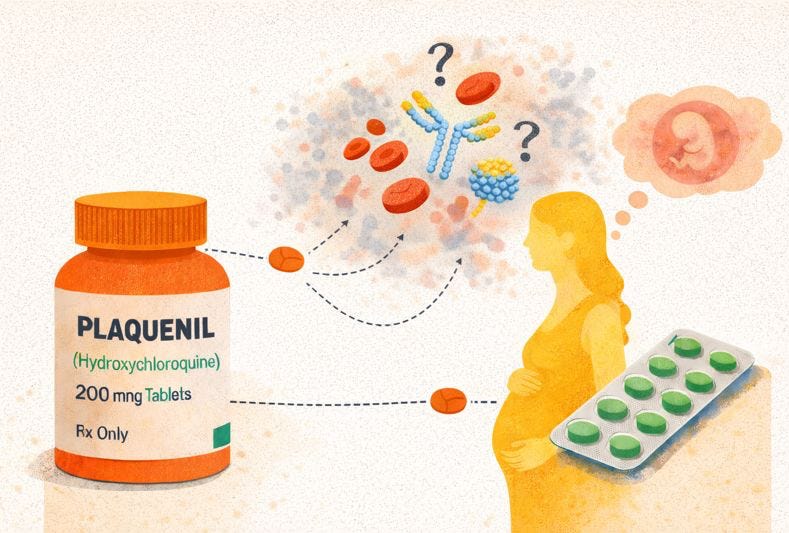
Just as we here at the CHR very definitely for decades have had all the love in the world for the commonalities between pregnancy- and self-tolerance, we over all of these decades have also had a clear dislike for what our rheumatology colleagues have come to call (and with definitions, even the name over the years has changed) the anti-phospholipid syndrome (APS). And while there are several reasons for our dislike, the principal one has been that we see it as a “concocted” syndrome/diagnosis.
Its history started many decades ago in New Zealand when an internal medicine practitioner in a hospital ward coincidentally noted several women who had just experienced a miscarriage, had deep vein thromboses, and were found to be positive for the so-called lupus anticoagulant (LA), and reported the case series in The Lancet.¹ It was then an important new observation, which the CHR’s Norbert Gleicher, MD, was one of the first to follow up on in an article in JAMA by pointing out that the syndrome was not only defined by a positive LA but also by autoantibodies.²
But then our rheumatology colleagues took over and established the so-called anti-phospholipid antibody syndrome (APAS) as an independent clinical diagnosis, initially defined as a woman with positive LA, a history of thrombosis, and repeated miscarriages. And that never made sense to us because how can one make a diagnosis dependent on a history of pregnancy (without pregnancies, there, of course, are no miscarriages)? What about women who never got pregnant? And what about men?
Unsurprisingly, names as well as diagnostic phenotypes changed, but never to a degree that made us here at the CHR comfortable with this diagnosis, especially relating to pregnancy. But this, of course, does not mean that we are ignoring the topic when addressed in the medical literature. To the contrary, as anything autoimmunity-related, we follow the subject with great interest and, therefore, here we present a newly published study by mostly Israeli investigators which, in a systematic review and meta-analysis, attempted to determine whether hydroxychloroquine use in APS represented effective treatment.³
By way of background, it is generally believed that women with APS have a higher pregnancy risk and that roughly 20%, despite what is considered appropriate treatment, will still miscarry. Our rheumatology colleagues love the anti-inflammatory hydroxychloroquine (Plaquenil) as a treatment in pregnancy for several autoimmune conditions, including APS, arguing that it offers, especially in regard to miscarriage risk, outcome improvements. Through a systematic review and meta-analysis of the literature, they now claimed to have confirmed the positive outcome effects of the medication in pregnancy by increasing live birth rates significantly (i.e., reducing miscarriage risks) and lowering obstetrical risk in general.
To say it mildly, we are skeptical!
While acknowledging our well-known bias against systematic reviews with meta-analyses (in most cases, basically only confirming the old IBM dictum: “garbage in, garbage out”), the circular thinking pattern, even further enhancing this dictum in this case, deserves further comment. The paper noted in the Introduction section that in APS, LA, anti-cardiolipin antibodies (ACAs), anti-beta-2-glycoprotein-1 antibodies, previous pregnancy loss, a history of thrombosis, and a history of systemic lupus erythematosus (SLE) are all associated with increased risk for adverse pregnancy outcomes.
In other words, as noted earlier, if you haven’t had pregnancy losses, you don’t qualify—but if you have SLE, you do qualify. But how does one differentiate between SLE and APS, causing adverse outcomes? And why only ACAs and anti-beta-2 antibodies among anti-phospholipid antibodies (APAs)? The truth is that they are the only APAs tested in most laboratories.
In other words, studies on the ACA basically never have the same uniformly defined patient population. As readers of the CHR VOICE by now, of course, know, this turns every meta-analysis into a crapshoot!
And since we are already talking about a crapshoot, the study included only seven retrospective (!) cohort studies and not even a single prospective cohort study (one, of course, can only dream about prospectively randomized studies). In short, this study would make a very good case study on how not to do systematic reviews with meta-analyses and, therefore, very clearly deserves a WORST PAPER AWARD.
This, of course, does not mean that hydroxychloroquine/Plaquenil may not have benefits in the treatment of certain autoimmune diseases, but let’s be honest about what we do and do not know! And to our rheumatology colleagues, we still don’t like the concept of the APS!
References
Lubbe W, et al. Lancet. 1983;321(8338):1361–1363.
Gleicher N, Friberg J. JAMA. 1985;253:3278–3281.
Berman J, et al. Rheum Musculoscelet Dis Open. 2025;11(3):e005825. WORST PAPER AWARD