

Following Women Who Spontaneously Conceived at Very Advanced Ages (Methuselah Moms) - A New Age Definition Appears in Place
For over 20 years, there has been the impression that a group of older women exists who – primarily because of their genetic predisposition – are still capable of conceiving spontaneously. Much of this hypothesis was based on a 2004 paper, which reported on a large number of Israeli women (among them, many Israeli Arabs) who had conceived spontaneously and delivered above age 45. They were widely considered to be of a very advanced maternal age, and some of these mothers were even given the name “Methuselah Moms.” The rarity of these spontaneously occurring pregnancies at advanced ages very likely also contributed to the infertility field’s longtime prevailing belief that the successful pursuit of autologous pregnancies after the maternal age of 43 is practically futile. Still enamored with this seemingly important 2004 paper, we decided to take – after many years – another look at it, - only to discover a likely “new truth.”
The CHR’s Editorial Staff

By Norbert Gleicher, MD, Medical Director and Chief Scientist, at the Center for Human Reproduction in New York City. He is also the Editor-in-Chief of the CHRVOICE and The Reproductive Times and can be contacted though either the CHR’s editorial office or directly at either of his two e-mails: ngleicher@thechr.com or ngleicher@rockefeller.edu.
In the medical literature, the Center for Human Reproduction (CHR) still holds the record for the oldest woman delivering an offspring with the use of autologous oocytes, who was two weeks short of age 48 when she had her embryo transfer.1 And even though we have not had older women than that deliver, we have had older women conceive and miscarry. Moreover, autologous pregnancies and deliveries of pregnancies over age 45 – in the infertility literature still treated as “ancient” – can no longer be considered a rarity, at least at the CHR.
Yet even we at the CHR are puzzled by the fact that while no autologous IVF pregnancies over age 48 have been reported in association with IVF, spontaneous pregnancies after that age have been sporadically reported in the medical literature for decades. And nobody has studied this subject with more intensity than old CHR friend and colleague from Israel, Neri Laufer, MD, who made his scientific name in the early IVF days in the U.S. (Yale and Mount Sinai, NY) and later as Chair and professor of OB/GYN at the Hadassah Medical Center and Hebrew University in Jerusalem, Israel.2
And though already retired for several years, his work going back to 2004 is still puzzling us. He then published a by-now classical paper on a substantial group of women who delivered an infant after a spontaneous pregnancy after the age of 45 years.2 His collection of Methuselah Moms, indeed, included a then quite astonishing number of 209 women. This is important because this number can be assumed to include a significant number of women who conceived at age 44 and then delivered at age 45 (a difference of one year matters here!).
And his paper reported the following: The mean (±SD) age at last delivery was 45.7 ± 0.9 years (range: 45–49). The mean parity was 9.6 ± 4 children (range: 2–20): 81% of the women were grand-multiparas (≥6 deliveries) and 46% were grand-grand-multiparas (≥11 deliveries). The mean number of spontaneous abortions (SAB) was 1.9 ± 1.9 (range: 0–9). Increased parity did not have a protective effect on abortion rate: 12.9% for parity 2–5, 15.6% for parity 6–10, and 21.3% for parity 11–20. Women in the study group differed significantly in their SAB rate from a general population: 11.3% vs. 17.7% at age 39, 13.2% vs. 33.8% at age 44, and 9.1% vs. 33.8% at age 45 (see Figure below).
Laufer and colleagues, of course, logically concluded then that women who delivered at or after 45 years of age were mostly grand-multiparas. They also correctly hypothesized that this unique group of grand-multiparous women might possess a genetic propensity that delays the normal rate of ovarian and oocyte senescence.
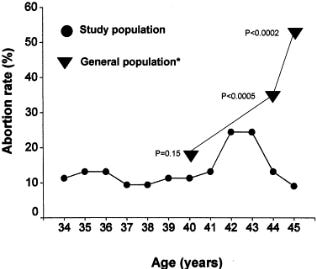
That is, of course, one possible explanation; but it is not the only one, and it is also possible that underlying genetic and non-genetic causes share responsibility. And while the very low miscarriage rate in this population, in comparison with age-specific by parity unselected women, supports a genetic causality, one, of course, can argue that almost everything in medicine is “genetic.”
But one can also ask what came first in these women (egg or chicken?), - a genetic predisposition, a mechanistic explanation that suggests that early (by age) and frequent use of a physiologic function (like spontaneous conception), or both in combination strengthens its performance and, thereby, achieves its repetition. In other words, the question arises whether grand-multiparity is causally related to still-spontaneous conceptions at advanced ages, better quality of pregnancies, and, therefore, fewer miscarriages. Starting early and doing something (in this case, having babies) more frequently may simply get all engines performing at their best. This is what, after all, recently has been increasingly emphasized in male infertility, - where increased ejaculation frequency has in general been associated with improved semen quality.3
One more interesting point is worth noting: The median age at delivery of Laufer’s patient group in 2004 was 45 years, meaning that they conceived at median ages of 44-45 years. This is, however, exactly the median age of the CHR’s patient population over at least the last three years as we reported in the literature, suggesting that Laufer’s group of spontaneously pregnant women who delivered were not really as old as they were made out to be.
They on first impression may appear unusually old because in the U.S. (and likely also elsewhere in the world), the median age of women undergoing autologous IVF – for quite some time – has been fixed at approximately 36 years (likely a consequence of women after ages 42-43 being quite automatically advanced into egg donation).
Defining female patients at ages 44 or 45 as Methuselahs may, therefore, no longer be appropriate, - especially as we have demonstrated in the CHR’s patient population increasing ongoing pregnancy rates from 8% in 2022 to 10% in 2023, and 12% in 2024/2025 if these women produced even only one day-3 embryo for transfer in their IVF cycle.
With the autologous pregnancy and live birth rate in IVF reported up to age 48, the above-noted pregnancy rates clearly appear to exceed spontaneous pregnancies in these age groups. They most certainly, however, don’t underperform them, and Methuselah Moms, therefore, require a new age definition.
We, indeed, would suggest that a real Methuselah Mom is only a woman who, either through spontaneous conception or IVF, establishes an ongoing pregnancy after age 50. One, of course, wonders how many of those really do exist after spontaneous conception (as noted, - after IVF, none of them have been reported so far beyond 48).
We, moreover, would argue that, considering the increasing frequency of ongoing pregnancies up to ages 47-48 years, IVF already appears to be doing better than spontaneous conception. It, therefore, appears time to reject the myths of genetically specially endowed women somewhere on this planet achieving motherhood at especially advanced ages. As is the case in biology in practically all of its functionality – and everywhere – these data strongly suggest that we are dealing here only with the usually progressively poorer statistical probabilities that come with advancing age and – whatever the reason(s) for this decline – ultimately, IVF will beat out spontaneous conception at very advanced ages, - just as it does at younger ages.
REFERENCES
Gleicher et al., Reprod Biomed Online 2018;37(2):172-177
Laufer et al., Fertil Steril 20004;81(5):1328-1332
Clay N. Ejaculatory frequency and male fertility: a literature and evidence-based recommendation. Transl Androl Urolog 2026;15(2):63