

New Studies About Pregnancy, Obstetrical Practice, and Immunology with Relevance to Reproduction

Today’s posting covers topics that should be very familiar to readers: the debated use of Tylenol during pregnancy, COVID-19 vaccinations for pregnant women, and the potential impact of Long COVID on some fertility patients. Though these subjects have all been addressed numerous times in lay media at this point, it’s always worth examining the latest scientific research on these matters, as the newest updates may go underreported in some larger news publications. As always, we welcome your comments and discussion.
The CHR’s Editorial Staff

More on Acetaminophen (Tylenol) During Pregnancy and the Risk of Autism in Offspring
This is, of course, a subject addressed exhaustively in medical journals and the lay press, but the study here presented was a very large Danish nationwide cohort analysis, involving more than 1.5 million children born between 1997 and 2022 that examined whether prenatal exposure to acetaminophen (Tylenol/paracetamol) was associated with autism risk in offspring.
And the main conclusions were that (i) after adjusting for confounding factors, the researchers found no meaningful association between acetaminophen use during pregnancy and autism in children. (ii) Absence of association persisted across different pregnancy trimesters, at low and high exposure levels, and in sibling-comparison analyses designed to reduce genetic and family-environment confounding.
Earlier studies suggesting a link may have been affected by “confounding by indication” — meaning that women taking acetaminophen during pregnancy may differ medically from women who do not, and those underlying differences, rather than the drug itself, may explain prior signals.
Clinically, the article very convincingly supports the current view that acetaminophen remains one of the preferred pain and fever medications during pregnancy, when medically indicated.
REFERENCE
Philipsen Prahm, et al., JAMA Pediatrics. 2026, Online ahead of print. Doi: 101001/jamapediatrics. 2026.0646
More on COVID-19 Vaccines in Pregnancy
Yes, we know that everybody is tired of hearing more about COVID-19 vaccinations in pregnancy, but even though COVID is no longer the threat it used to be, it still exists endemically in the U.S., and it still is a more severe disease in pregnancy than in the non-pregnant state. Information about vaccinations, therefore, is still of importance.
This is why we here report on an interesting recent study from Norway, which examined associations between COVID-19 vaccination during pregnancy and the risk of various subsequent infections of offspring in early childhood. And the results were really interesting: COVID-19 vaccination during pregnancy protected the offspring against hospital contact for COVID-19 during the first 6 months of life, but no apparent effects were observed for other infections, demonstrating that the protection is highly specific. This is an important finding because there exists considerable evidence that under different conditions, cross-reactivity can exist with other flu-like viruses (see Figure below).
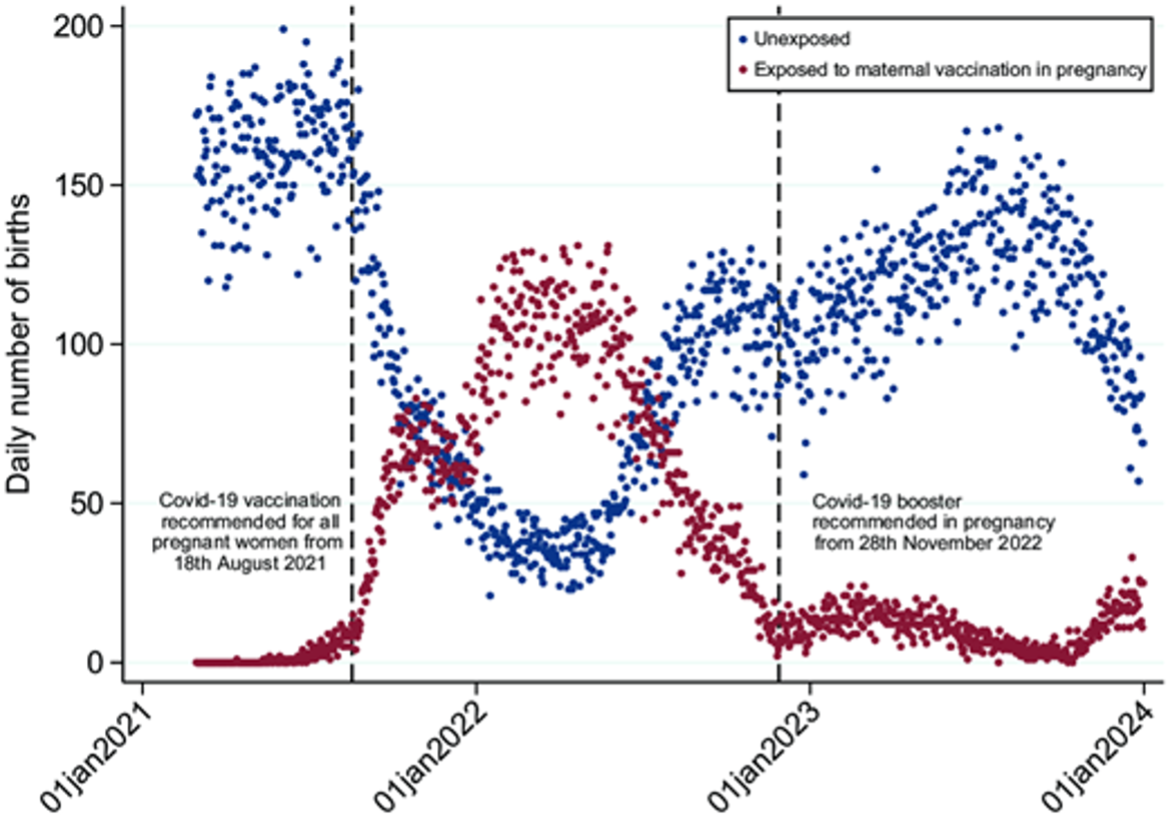
In summary, maternal vaccination against COVID-19 during pregnancy offers a waning protection to the offspring against hospital contact for COVID-19 in the first 6 months of life.
But here is more exciting news from two papers in JAMA and eClinicalMedicine (a Lancet journal), respectively: The JAMA paper, in a study of 26,584 cases, of which 19,899 were eligible for analysis, reported that vaccination prior to and during pregnancy (before diagnosis of COVID-19) was significantly associated with lower risk of severe maternal disease and preterm birth, regardless of variant time period.2 The eClinicalMedicine article, in turn, involving no fewer than 69 authors from 18 countries all over the world, reported a truly astonishing finding: COVID-19 vaccination with a booster reduced the odds of preeclampsia (PE) by 30%, approaching 60% reduction among women with pre-existing morbidities.3
And here is the full story: The authors confirmed the previously suggested independent association between COVID-19 and PE (aOR: 1.45; 95% CI: 1.15–1.84), particularly in unvaccinated women (aOR: 1.78; 95% CI: 1.31–2.42). Overall, after adjusting for confounders, any vaccination offered protection against PE during the index pregnancy (aOR: 0.85; 95% CI: 0.65–1.10), further strengthened with a booster (aOR: 0.67; 95% CI: 0.45–0.99). Among women with pre-existing morbidities who received a booster dose, the odds were reduced by 58% (aOR: 0.42; 95% CI: 0.20–0.87) – mainly observed in women diagnosed with COVID-19. Adjustments did not alter the magnitude of the effect. Vaccination amongst women who received a booster dose was also associated with decreased odds of maternal (aOR: 0.68; 95% CI: 0.55–0.83) and perinatal (aOR: 0.71; 95% CI: 0.54–0.95) morbidity and mortality, and as in the JAMA study – with preterm birth (aOR: 0.67; 95% CI: 0.53–0.85).
These findings are not only remarkable in their very obvious and here-summarized detail, but, potentially, also offer important insights on a completely different level: The fact that these vaccinations demonstrate such an enormous effect on PE, increasingly understood as a condition of dwindling immune tolerance of the mother toward her fetal-placental unit – strongly implies that these vaccines affect the maternal immune system by “replenishing” its capacity for tolerance. If correct, this would suggest that PE may be preventable through timely vaccinations.
REFERENCES
Eide HN, et al., Pediatrics. 2026;157(4):e2025073661
McCkaymont et al., JAMA 2026;335(2):154-162
Cavoretto, et al., eClinicalMedicine 2026; 103785
Long COVID Activates Proinflammatory and Immune Exhaustive Pathways
And since we are already on the subject of COVID, here is some insight on Long COVID, which – fortunately only rarely – we also have started seeing in some infertility patients.
Long COVID (LC) involves a spectrum of chronic symptoms, and current hypotheses for the pathogenesis of LC include persistence of the virus, tissue damage, autoimmunity, endocrine insufficiencies, immune dysfunction, and complement activation. It finally appears that some mysteries of Long COVID are slowly revealing themselves. Within that context, a recent paper in Nature Immunology was a good example when it demonstrated that in so-affected patients, proinflammatory pathways are persistently upregulated. These are potentially important discoveries because they may lead to new therapeutic targets for this condition and may also allow for discovery of new potential biomarkers for the disease.1
REFERENCE
Aid et al., Nat Immunol 2026;27:61-71