News About Immunology With Relevance to Reproduction
Today’s posting covers two interesting updates on immunology, both related to the reproductive medicine field. One news item focuses on the maternal immune system’s adaptation to pregnancy, which helps lead to reproductive success, and the other focuses on eosinophils, a granulocyte often associated with allergies and helminth infections, which was recently found to play a role in remodeling the intestinal barrier during reproduction. It just goes to show how almost everything in our bodies connects with something else in our systems. As always, we are welcoming comments from our readers.
The CHR’s Editorial Staff

More News on How the Maternal Immune System Adapts to Pregnancy
We here report on a very interesting recent paper in Nature magazine by investigators who – using a mouse model – reported previously unknown intestinal immune-responses in pregnancy. By way of background, the authors in their paper pointed out that mammalian reproduction requires substantial immune adaptations to safeguard reproductive success and to ultimately shape the evolutionary trajectories of a species.
Practically, this means that systemic and placental immunity shift toward tolerance (also a reason why several autoimmune diseases clinically improve in the mid-phase of pregnancy when tolerance is at its peak). The authors, however, also noted that how maternal immunity adapts in barrier tissues – which are sites of frequent infection and inflammation and, therefore, do need good immune responses – is not yet well understood.
They, therefore, investigate this in the intestines of mice, as intestines in all species are, of course, frequently associated with (food) allergies and all kinds of infections, including parasitic helminth infections. What they found was a previously unrecognized role for eosinophils, a type of granulocyte typically associated with allergies and helminth infections, in remodeling the intestinal barrier during reproduction.
Beginning in pregnancy and peaking during lactation, eosinophils accumulate in the small intestine in the absence of infection or inflammation. The authors further demonstrated that eosinophils promoted goblet cell differentiation in a stem-cell-intrinsic manner that led to increased protective mucus production. This remodeling indeed culminated during lactation and limited the entry and dissemination of pathogens conferring broad innate protection against enteric bacterial infections. In mice, this intestinal remodeling and innate defense, indeed, persisted for weeks beyond cessation of lactation.
The authors concluded that despite a general trend toward systemic immune modulation during reproduction, the maternal intestine undergoes remodeling to strengthen innate defenses, a mechanism that may have evolved to protect mothers and offspring in pathogen-rich environments. They also claimed to have established a framework for studying tissue-specific immune adaptation across the reproductive cycle, - highlighting that tissues can retain changes following physiological reproduction, with lasting implications for host defense and women’s health.
All of this is, of course, incredibly interesting and important for everybody interested in reproductive immunology (which we here at the CHR always are). This paper, however, made an additional impression on us because we – for some time – have been struggling in explaining observations in abnormal peripheral eosinophil counts and IgE antibody levels in an unusual number of our female infertility patients. And allergen-specific IgE and eosinophils, especially in allergic diseases and parasitic infections, are closely connected.
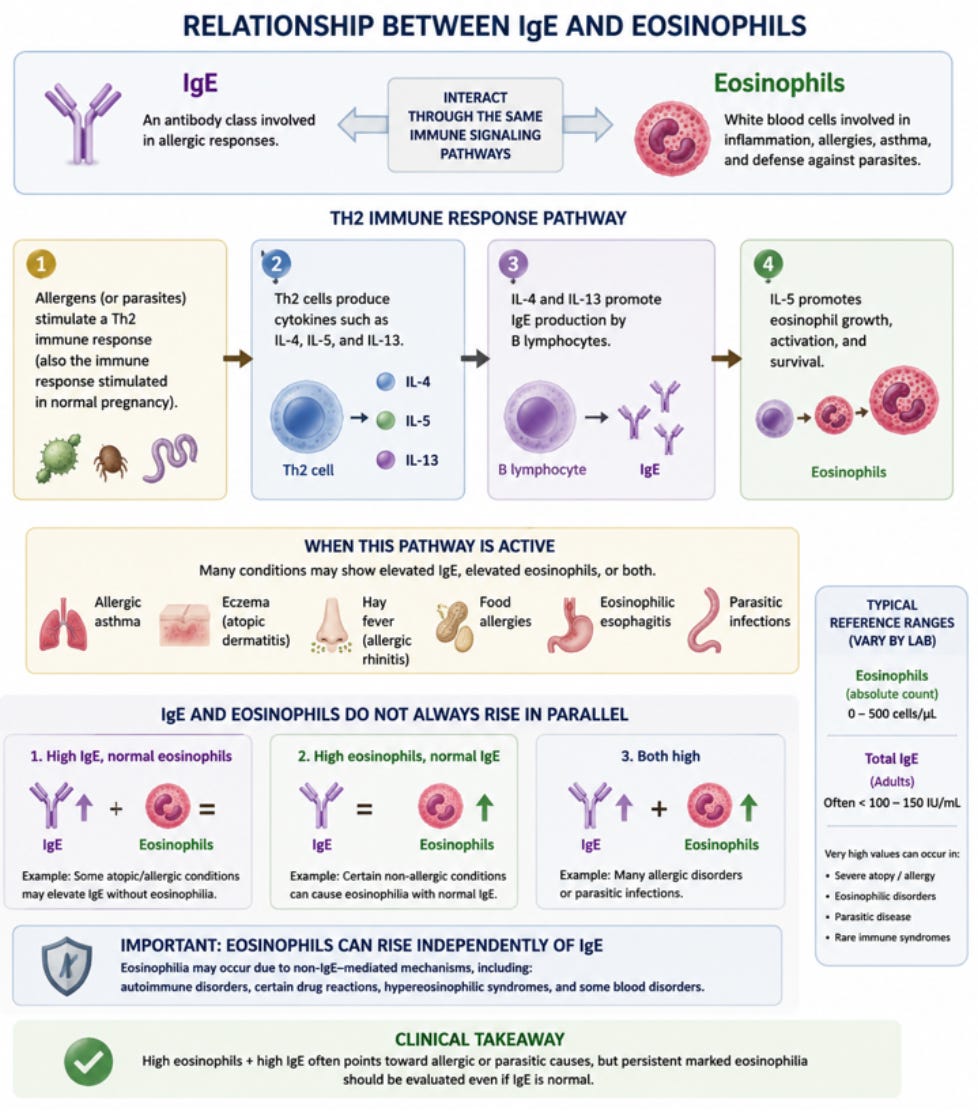
Specifically, IgE is an antibody class involved in allergic responses. Eosinophils, in turn, are white blood cells involved in inflammation, allergies, asthma, and defense against parasites and they interact through the same immune signaling pathways: Allergens (or parasites) stimulate a so-called Th2 Immune response (which is also the immune response stimulated in normal pregnancy). Th2 cells produce cytokines such as IL-4, IL-5, and IL-13, with IL=4 and IL-13 promoting IgE production by B lymphocytes and IL-5 promotes eosinophil growth, activation, and survival (see Figure below). But IgE and eosinophils do not always rise in parallel.
This paper, therefore, potentially directs us toward the gut of female fertility patients with abnormalities in IgE and eosinophil counts. And we like nothing as much as papers that give us new ideas for the CHR’s research.
REFERENCE
Huang et al., Nature 2026;654:209218
And More News on Eosinophils
And as further evidence that almost everything in our bodies is connected to everything else, a study just published in Science detailed a neuro-immunological mechanism in which psychological stress exacerbates skin inflammation, defined by a specific sympathetic-eosinophil axis that links mental stress and atopic dermatitis flare-ups.1
That psychological stress can exacerbate dermatitis has been well established, but the mechanisms involved in this process have remained unclear. The authors of this very interesting study now identified a subset of prodynorphin-positive (Pdyn+) noradrenergic sympathetic neurons in mice that specifically innervate hairy skin and mediate stress-induced exacerbation of skin inflammation in eosinophil-dependent manner. Genetic ablation of these sympathetic neurons or of eosinophils-mitigated stress-drive worsening of inflammation in atopic dermatitis-like mice, while optogenetic activation of neurons recruited eosinophils through the CCL11-CCR3 axis, activating them in inflamed skin through the adrenergic receptor beta2(Adrb2), - a finding that will likely lead to more effective treatments of atopic dermatitis should this axis also be active in humans.
REFERENCE
Tian et al., Science 2026 391(6791):1269-1277
In New York City this September 9th? Come enjoy the Center for Human Reproduction’s 25th Anniversary Gala at the iconic venue Guastavino’s! The gala boasts world-class entertainment and celebration, including the 400-year cultural dance Awa Odori. Reserve your seat here.